
Technology is changing not only the tools we use, but the nature of work itself. The World Economic Forum’s Future of Jobs Report 2025 estimates that technological and other structural changes could create 170 million new jobs globally by 2030 while displacing 92 million existing roles. It also estimates that 39% of the skills required in today’s jobs will change over the same period.
For education, this raises a larger question than how technology can be added to existing teaching methods. As the ways we work, communicate and create change, students need opportunities to develop both technological capabilities and the human skills that remain essential, including creative and analytical thinking. The OECD is now calling for education systems to reconsider not only what students learn, but how learning experiences and teaching practices should evolve in response to rapidly developing technologies.
Digital technology is therefore becoming part of the environment in which learning takes place, rather than simply another tool within it. The challenge for educators is to use these technologies with a clear educational purpose: to create opportunities for students to investigate, create, communicate and develop skills that will remain relevant as technology continues to change. \For art and design students in particular, this can include learning how to work within new forms of digital space. A virtual gallery provides an environment in which students can create, curate and present their work as an exhibition, bringing together creative practice with digital communication and spatial thinking.
Three-dimensional virtual environments have existed for decades, but their educational potential continues to develop as digital technologies become increasingly embedded in everyday life. Unlike a conventional webpage, a virtual gallery gives students a space in which artworks can be positioned, sequenced and experienced in relation to one another.
Exhibbit allows students and educators to create these exhibitions without requiring VR headsets or other specialist hardware. Exhibitions can be accessed through desktops, tablets and smartphones, making the technology available within the devices students already use.
This does not mean replacing the physical gallery or treating digital presentation as a substitute for established forms of art education. Instead, it adds another environment in which students can develop and apply their skills.
A virtual exhibition can require students to think beyond the production of individual artworks. They must consider how the work is organised, how different media relate to one another, how an audience will move through the exhibition and what they want that audience to notice, hear or discover. In doing so, the digital environment becomes part of the learning activity itself.
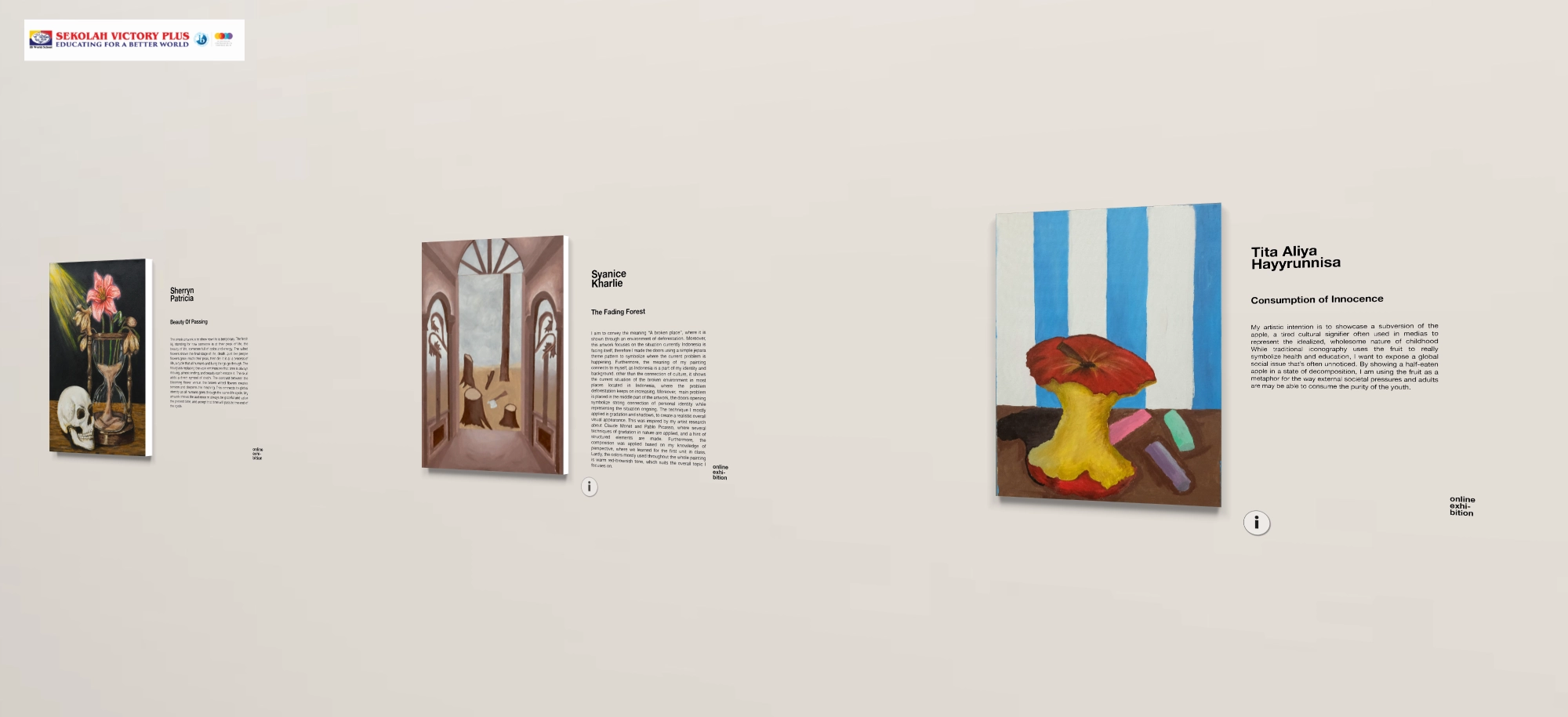
The value of educational technology lies not just in giving students access to new tools, but in creating meaningful opportunities to use them. The OECD’s recent work on digital education makes a similar distinction, emphasising that technology is most valuable when its use is guided by pedagogical purpose and supports the development of human capabilities rather than replacing them.
For students, working with a virtual exhibition can therefore be more than learning how to use a new piece of software. It involves making decisions, problem solving and communicating their ideas.
As digital environments become an increasingly ordinary part of professional and creative life, education has an opportunity to give students experience of working within them; not just consuming digital content, but creating, organising and communicating within digital spaces.
 Curate and manage your own virtual art gallery using our bespoke 3D exhibition software.