
By placing artworks within a navigable three-dimensional environment, Exhibbit gives students, educators and researchers another way to present their work, one that invites visitors to move through the exhibition and choose what to explore and engage with. Exhibitions can be private, or remain accessible beyond the classroom or physical gallery, giving the work a continuing presence online.
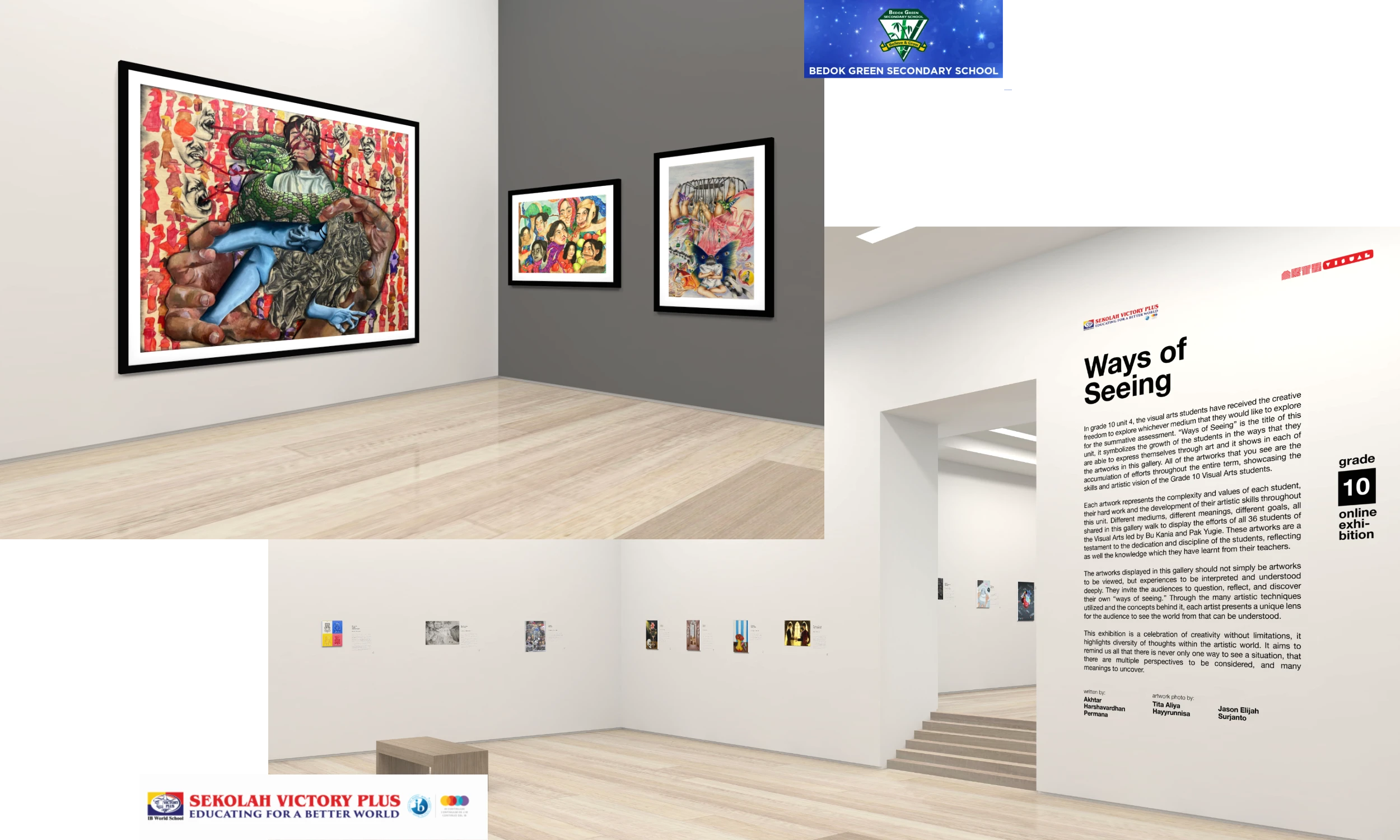
In 2026, Grade 10 Visual Arts students from Sekolah Victory Plus, an International Baccalaureate school in Bekasi, Indonesia, created Ways of Seeing as their Unit 4 summative assessment. Students were given creative freedom to work in the medium of their choice. The resulting exhibition brings together different mediums, meanings and artistic intentions developed throughout the term. For the students, the exhibition provides a finished presentation of their work and a record of their development in visual art.
At the University of North Carolina Wilmington, graduating Studio Art students present their work through exhibitions in the university’s physical galleries. Exhibbit is being used to create online versions of these exhibitions.
The virtual exhibitions provide an additional way for graduating students to present their work while extending the life of the exhibition beyond its physical gallery dates. This creates a digital record of the graduating exhibition.
The university gallery also uses Exhibbit for exhibitions beyond student degree shows, including exhibitions by artists associated with the local community. One example is Numbers in the Dark, an exhibition by Jovencio de la Paz, Associate Professor and Head of Fibers at the University of Oregon.
At the University of Calgary, Exhibbit has been used to present Photography, Memory and Migration, an exhibition organised as part of doctoral research.
Curated by Amanda Zanco, the exhibition has photographic works by six artists exploring migration through themes including return, homecoming, community, identity, agency and womanhood. It brings together different artistic perspectives to create a broader consideration of migration and the personal experiences behind it.
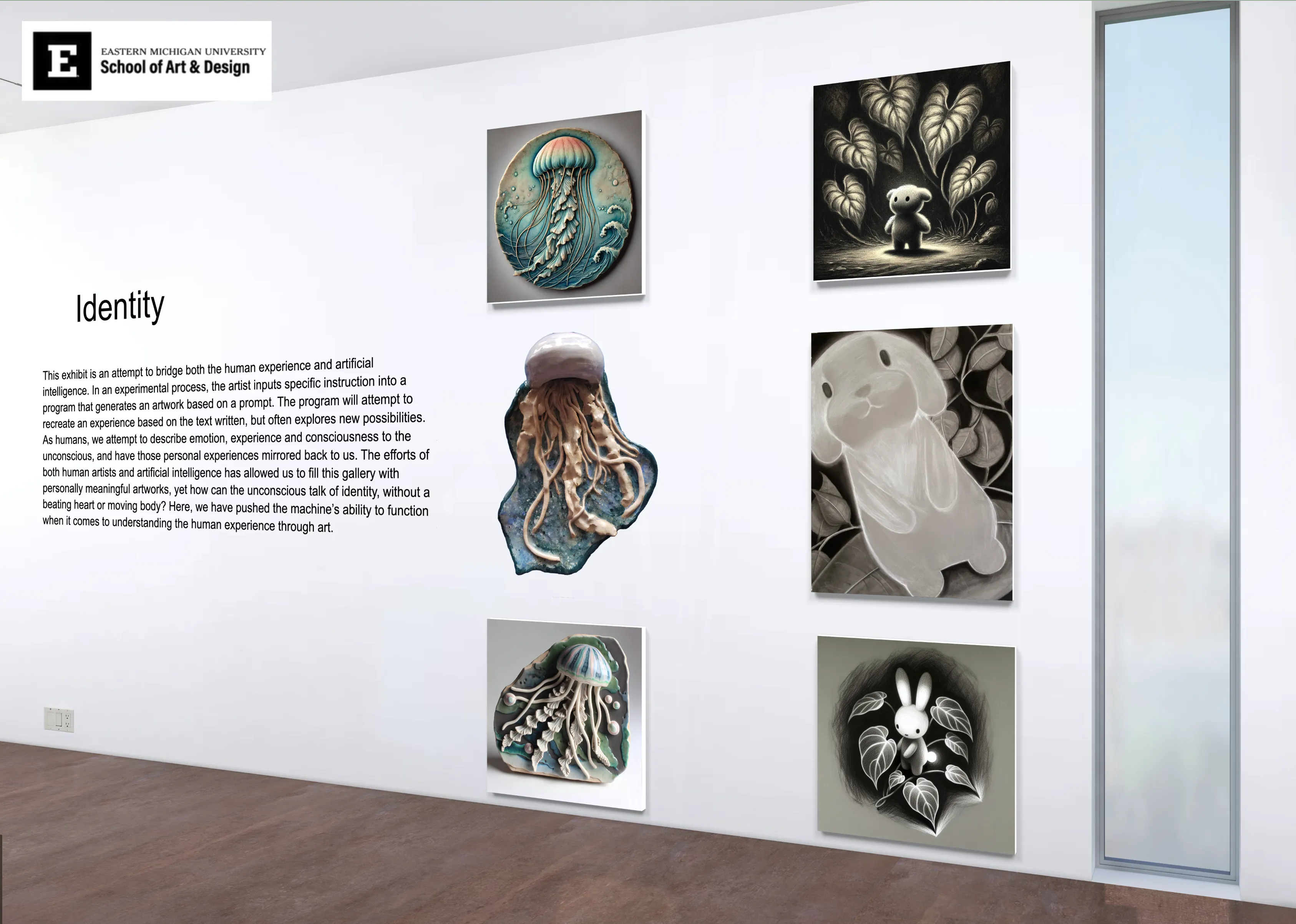
In an attempt to bridge the human experience and artificial intelligence, students at the School of Art and Design Eastern Michigan University have been curating exhibitions using artworks created with AI prompts. Art History Professor Tom Suchan describes Exhibbit as an effective and engaging platform for his students to conduct independent research and experience exhibition-making.
At Teachers College, Columbia University, students have used Exhibbit to present a group exhibition. For students developing their own creative and teaching practice, the virtual gallery provides a space to present not only their finished work, but also the thinking and development behind it, making the exhibition useful as a presentation and assessment environment.
A space for different forms of expression
Student exhibitions do not have to be limited to still images. Students can combine artworks with video, audio, text and other digital material, deciding where each element appears and how it is encountered. Media can be positioned within the exhibition to contribute to the overall experience rather than simply being presented as additional content. This gives students greater control over the relationship between their work, the space and the visitor, allowing them to consider not only what they want to communicate, but when, where and how an audience encounters it.
When Looking Becomes Exploring
A virtual gallery does not replace the simplicity of viewing artworks on a webpage. It offers another way of encountering them. A grid gives the viewer an arrangement of images; a spatial environment introduces position, movement, proximity, scale, sequence and choice. These characteristics change how the viewer regards the work.
The distinction is not that three-dimensional presentation is inherently better than two-dimensional presentation, but that spatiality creates another mode of engagement. The visitor is no longer simply moving from one image to the next. They are orienting themselves within an environment, choosing where to go, what to look at and how long to remain with it. The screen remains the medium, but the experience becomes more active and spatial.
For students, this changes what it means to present their work. They are not just deciding how an artwork should be displayed; they are considering how it will be experienced. Position, scale and proximity are part of the communication and the movement of a visitor becomes a consideration.
This kind of interaction is already familiar in many areas of digital life, from games and simulations to training environments. A virtual gallery draws on that same capacity for participation, but with a different purpose. There is nothing to win, complete or overcome. The environment instead creates the conditions for attention, exploration and contemplation. In this sense, the virtual gallery becomes more than a digital container for student work. It provides a spatial context in which students can consider not only what they want to present, but how they want it to be encountered.
 Curate and manage your own virtual art gallery using our bespoke 3D exhibition software.