
Robert Broughton’s latest exhibition, Cathedral of the Tides, shows what’s possible when a curator treats the gallery walls as more than a backdrop.
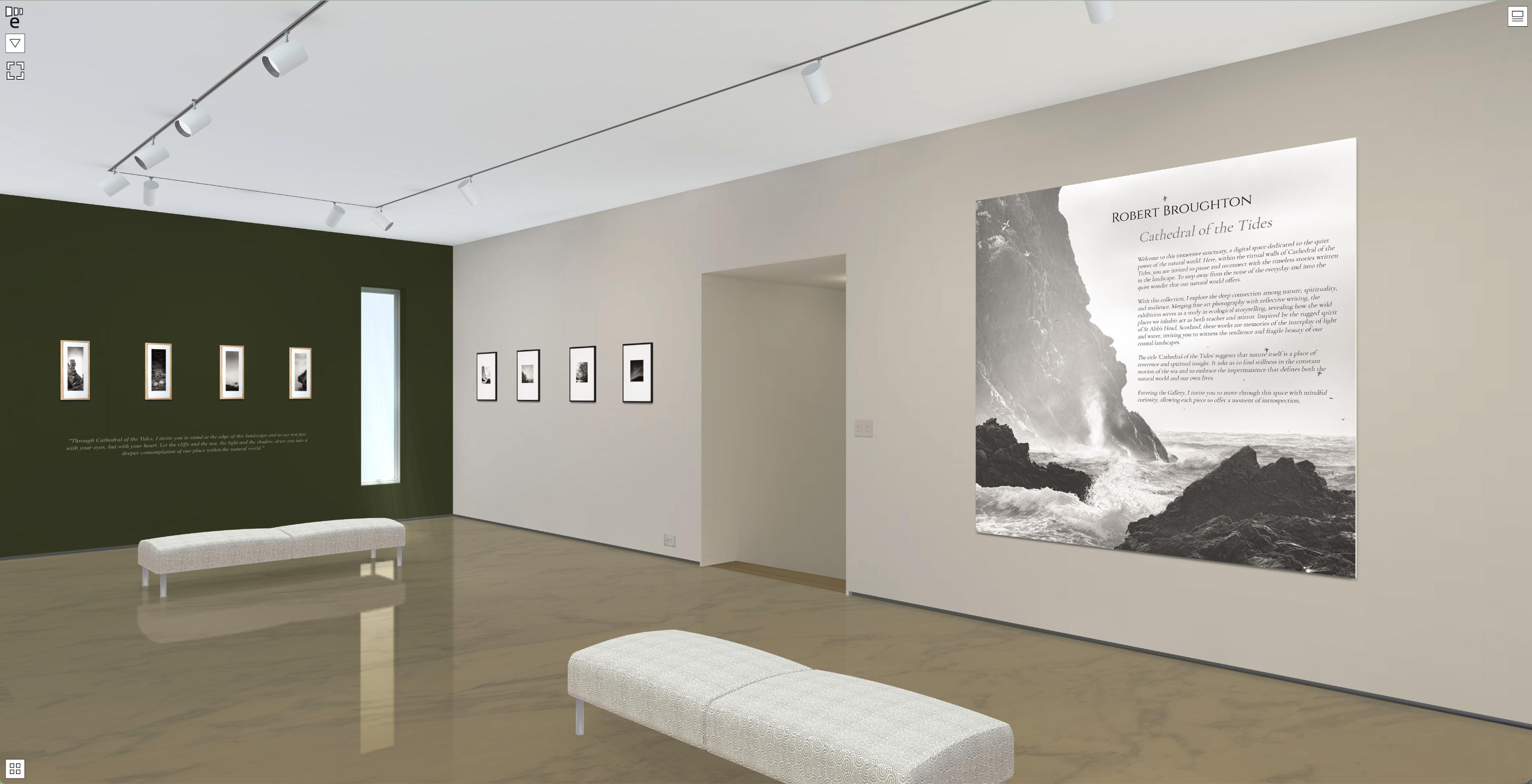
Large-scale murals sweep behind a series of framed monochrome photographs - a bold and unconventional use of space that pushes the technical boundaries of the 3D virtual gallery form - while a bespoke soundscape fills the silence and prose is presented with the same care as the images. What emerges is a space designed not simply to be viewed, but to be entered: a place that draws the viewer away from busyness and distraction and back towards stillness, connection, and perhaps even the elemental presence of the Scottish coast, or somewhere closer to home. That ambition is entirely in keeping with who Robert is.
A photographer, writer, and long-time teacher of mindful awareness, he has spent much of his life cultivating a way of seeing shaped by stillness, attention, and a sense of kinship with the natural world. For him, landscape is never mere backdrop but a living presence - to be approached with patience, reverence, and deep receptivity. That same sensibility runs through Cathedral of the Tides, where the space is designed to carry that gesture forward, inviting the viewer into a quieter, more contemplative relationship with both the work and the world from which it emerges.
The exhibition takes its name from Robert’s forthcoming book of the same title: a meditative exploration of St Abb’s Head in Berwickshire, Scotland, where ancient volcanic cliffs meet the North Sea, their basalt faces bearing the scars of deep geological time. The headland has long been recognised as both a sanctuary for wildlife and one of those rare, wild places where the boundary between the physical and the spiritual feels almost transparent. The book pairs monochrome photography with reflective prose, returning to the themes that run through his work: impermanence, resilience, and the quiet interconnectedness of people and the natural world.
I spoke with Robert about how that sensibility translated into a virtual exhibition space and what he discovered in the process.
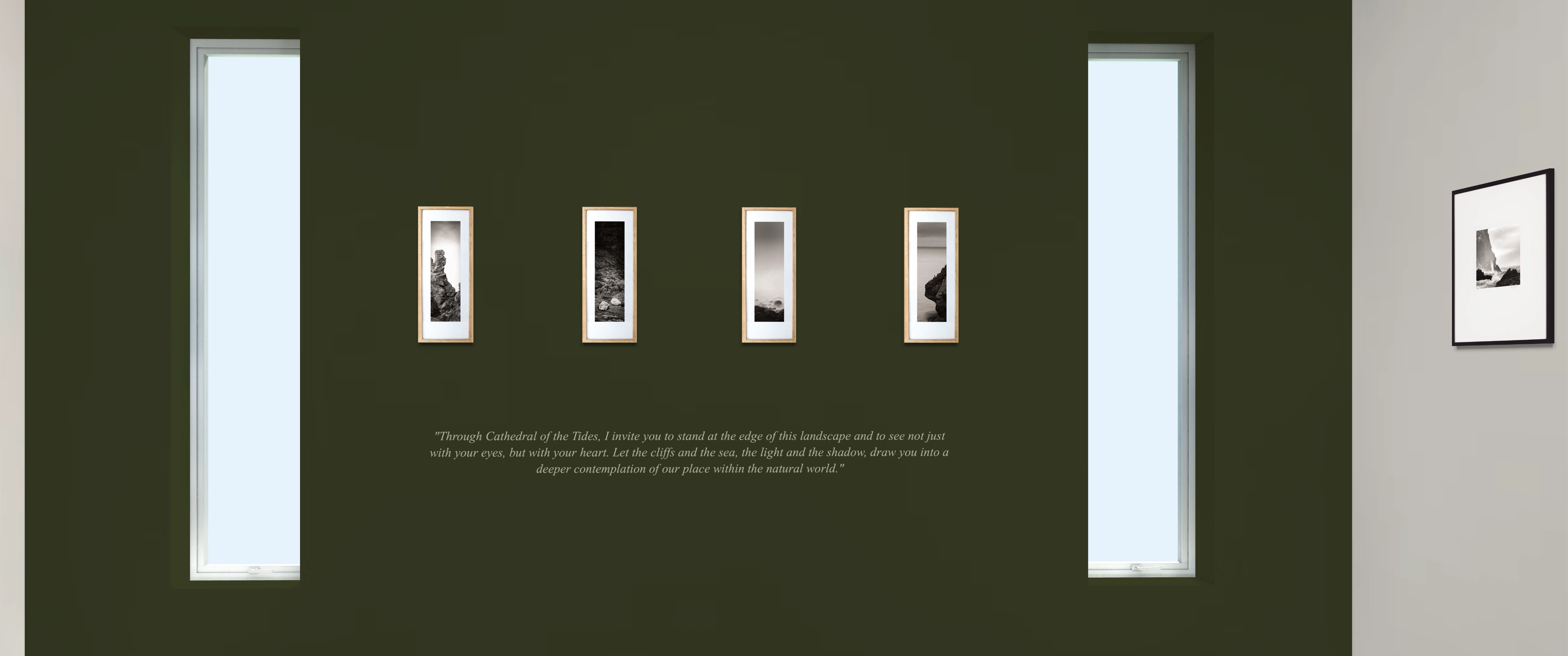
The walls of your gallery present more than a conventional exhibition of photographic prints. Did you have this design in mind before you found Exhibbit, or did it evolve as you experimented with the various elements you can add to your virtual gallery environment?
I knew the feeling long before I knew the form, I wanted to build a space that could still the mind, then quietly open and expand it. That intention came first, not a design. Everything else I had to discover. My work lives at the intersection of image and word, so I imagined a space that could hold both, a kind of digital ’thin place’ where the boundary between the observer and the observed begins to soften.
Throughout the process, I kept one idea close - a line from Mark Rothko: ‘A painting is not a picture of an experience, it is an experience.’ That became the measure for every decision. Was I simply assembling a display of images, or was I creating something someone could step into and engage with?
I have always felt we must approach the gallery space as an artwork in itself. We invest a tremendous amount of time and emotion in our artworks, and the gallery deserves the same care. It needs to be treated as an extended canvas that brings together all our work in a coherent, emotional, poetic way. It has to tell its own story. I wanted to give the gallery as much attention as I give to making an image in the first place.
While the intention arrived early, the form emerged through the making, through testing what the space could hold.
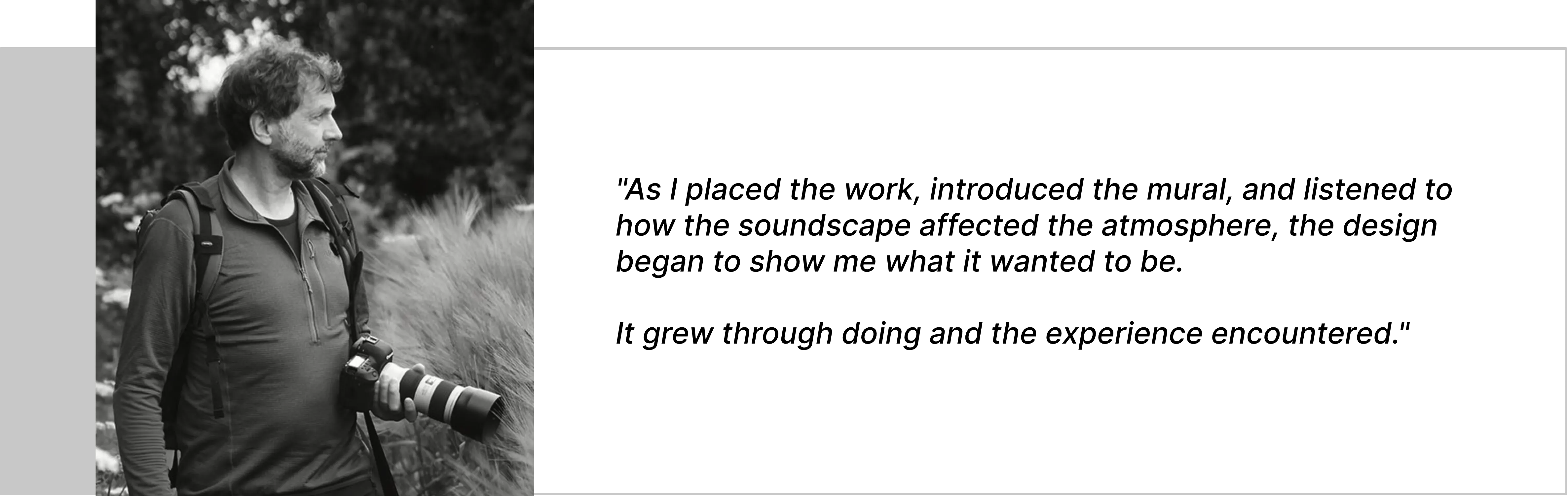
As I placed the work, introduced the mural, and listened to how the soundscape affected the atmosphere, the design began to show me what it wanted to be. It grew through doing and through the experience encountered. What took shape was not a concept imposed all at once, but a form found through patience, trial, and refinement.
Design, for me, is an organic process, one that’s closer to erosion than to construction. I start with more than I need. Then I arrange, rearrange, add, remove, and group. Each time I intervene, something changes:
the narrative shifts, the emotion shifts, the sense of space alters. I find it an intuitive and fascinating process (albeit, at times, very frustrating and a lesson in letting go). Each iteration gradually wears the whole thing down towards its true essence. What I am left with is not what I invented, but what survives.
There is a quiet gift in working this way. A physical show is fixed the moment it opens. Here, I could keep returning, refining, and asking whether each choice had earned its place. So what stands today is much richer than the initial impulse from which it began.
Covering the walls at that scale meant working on a mural running to 10 metres - you were really pushing at the edges of what the medium could do. What was that process like, and what did it take to get to a result you were happy with?
Challenging and genuinely instructive. You are pushing at the edges of what the medium can do, and the medium pushes back. Stretching a single illustration across ten metres exposes every weakness in resolution. The mural design took some work. There were moments when the scale or
placement of a feature - the mountain range, for instance - subtly shifted, quietly altering the sense of space and depth I was aiming for. Reaching for a result I was satisfied with required iteration, testing, and no small amount of collaboration.
Splitting the mural into panels improved the effective resolution. Small technical anomalies - the kind that hide beneath transparent pixels until an image is rendered at size - had to be tracked down and corrected. It was a reminder that design at this scale is rarely a single act of creation. It is a constant process of research, learning, and a patient series of adjustments.
What I found interesting, was how effectively the application’s technical capabilities served the emotional goal. The mural’s design was carefully considered, and I needed to soften it slightly, keeping it minimal and abstract, as I didn’t want the illustration to compete with the photographs. A gentler backdrop creates distinction and lends the whole space a sense of spaciousness. The mural, I feel, sets a mood; the photographs hold the attention.
Now that it’s built and people can visit it, how does it feel to experience the space? Has it opened up anything, creatively or otherwise, that you don’t think you’d have attempted in a physical gallery?
In designing this, I was very conscious that even in the finest galleries, attention spans are short. The research bears this out: studies of how visitors behave in galleries and museums suggest that the average person spends only about fifteen seconds on a single work before moving on. Fifteen seconds. For work that asks you to slow down, that is a quiet defeat before you have even begun. This awareness shaped everything. Rather than competing for those fifteen seconds, I designed a space that gently dismantles the hurry itself.
I did not want to grab attention. I wanted to release it. The monochrome does part of that work - removing colour strips away the easy visual shortcut and invites the eye to settle. The ambient soundscape slows the breath and draws the visitor deeper into the world of the photographs. The prose is placed sparingly, offered not to inform the mind but to open the heart. Each element is there to move the visitor from looking at - to being with. That shift is the whole point, and the feeling sought at the onset of the project.
Interestingly, an unexpected door opened through the platform’s navigation method. The spatial movement, using the keys to walk forward and turn, meant visitors had to slow down, to orient themselves and choose their path. That simple act of agency broke the passive trance of the screen and became, in itself, a first step into engagement and flow state.
The themes I engage with demand this depth of attention. Drawing on Jungian psychology and the philosophy of genius loci - the spirit of place - the cliffs, tides, and seabirds of St Abb’s Head are active participants in a psychological dialogue. The sea stands in for the unconscious: restless, vast, and generative. The cliffs become monuments to endurance - volcanic rock shaped by ancient fire, now worn smooth by centuries of waves and wind. The seabirds, nesting on the sheer edges of the headland, embody the audacity required to build upon the edge of forever. To meet that kind of meaning, a viewer has to linger. The space is designed to make lingering feel natural.
The virtual medium is different, in ways I did not expect. In a physical gallery, I could never wrap a visitor in a ten-metre
illustration, layer in sound, and sustain the whole thing in a single, continuous atmosphere - not at this
cost, and not at this scale. The virtual space let me build what I can only describe as a portable sanctuary:
somewhere the contemplative quality survives the move to a screen rather than being diluted by it. It has
genuinely changed how I think about presenting work. That said, I would still love to see this realised as a physical exhibition. There is something irreplaceable
about standing in a room with the work, feeling its presence in your body. That remains a hope.
A Quiet Ambition
What makes Cathedral of the Tides compelling, from our perspective at Exhibbit, is not simply that it extends the technical possibilities of a 3D virtual gallery - though it does. It is that every technical choice serves a human purpose. The scale, the images, the mural, the bespoke sound, and the restraint with text: all of it points in the same direction, towards a space that asks you to stop, breathe, and stay a while longer than you intended.
Exhibbit was built on the belief that an exhibition is more than a collection of artworks - it is an experience in its own right. The sense of discovery, context, and spatial awareness that makes visiting a gallery so engaging is worth preserving, even online.
Robert’s approach speaks to exactly that. His exhibition does not treat the virtual space as a compromise. Instead, it uses it as a medium - one with its own expressive possibilities, its own capacity for stillness, and its own ability to hold the contemplative space the work demands.
In an age designed for scrolling, that is a quietly radical proposition. Helping artists and curators realise that vision is a large part of why we do what we do.
 Curate and manage your own virtual art gallery using our bespoke 3D exhibition software.